Being a bad guy without being a “Bad Guy”

“You can be a bad guy without being a Bad Guy” – Zangief.

Explore the complexities and challenges of embodying morally ambiguous personas in role-playing games. Learn strategies to develop nuanced and compelling antihero characters, delve into the psychology behind their motivations, and navigate the delicate balance between immersion and maintaining a healthy gaming environment.
I had a little bit of anxiety heading into this panel. It was one that could have gone very wrong. I was asked/volunteered to be the moderator for this one. I started off with a bunch of notes and lots to say – but shifted to make sure I had a series of questions for the panelists to really dig into. I did lead into things by stating in my introduction that I had deep feelings about this topic that lead all the way back to the 1982 movie starring Tom Hanks as Robbie, the troubled college student in “Mazes and Monsters” (and I still think it’s unforgivable).

Here are the questions I came up with:

What are some techniques you have for creating the safe gaming environment you want?

Once you have the group / environment you want, do you set limits on what your characters can and can’t do? Follow up – how are we defining ‘bad guy’?

What are some strategies or approaches you can take as a player to be the anti-hero / bad guy without wrecking the game for everyone else?

As a game master, what tactics can you use to create compelling drama without letting the game play get out of hand?

What are your favorite aspects of playing out the ‘bad guy’ ~ and how do you do that while keeping in mind all those questions we just covered?

What are some strategies for taking steps back or making a move to help somebody in your group who is struggling?

I also wanted to include my notes here – before I was in charge of the discussion, here’s what I wanted to keep in mind:

One of the most enjoyable aspects of role-playing is exactly that – it’s a role. It’s not really YOU, right?

Creating a character that wants something is a part of this. Motivation, desires, needs… how do those make this character act? Is it the choice you’d make in the real world? Maybe not.

Give your characters secrets. What would they do to protect those secrets? Is honor vs. embarrassment a driving factor for your street samurai?

Consequences are NOT your consequences, but just because it’s not the real world doesn’t mean they don’t exist or won’t effect you.

Don’t become “that guy” or “that girl”. Yes, your character might be a bit homicidal. Deciding you’re in a bad mood so you’re going to kill all the other player characters is a group stopper. Don’t wreck it for everyone else. OR consider making your ‘bad guy’ character have a specific arc. Talk it out with the game master. A spectacular, massive, explody death is really memorable for the other characters and can push a story along. Yes, you need to make a new character, but that can be OK too.

Reasonable example: I played an anti-paladin. He was a cold hearted killer and had 0 remorse about it at all. He was being guided by a deeply evil wizard… who lied about being a ‘good guy’. We had to team up with 2 ‘good guy’ characters and a true neutral wizard to save the world (balance and all that). The group had a little bit of infighting based on goals, but it made for great tension and a spectacularly messy death for my character in the end.

Unreasonable example: I ran a big one shot session for a friend’s birthday. Co-DM with my friend John. Ten players – two teams of 5, each trying to claim the birthday throne. It was designed to be a battle royale. What happened was one player picked out another and just hounded her. Singled her out and didn’t let her do anything else except constantly defend or deal with being taken out of the action with any of the others. I found out after the fact that made the attacked person cry and now she’s not interested in playing anymore. Don’t be that jerk.

Making a Book Club Work


Selecting books, recruiting members, and achieving longevity; what goes into a successful book discussion group?

I suspect I was asked to be part of this panel because of my long term connection to Watch the Skies and our 25+ year history as a club. The pre-convention notes were a little thin on this one and I was a little concerned. Turns out there was no need to worry. It was a small panel crowd and lots of lively bits were covered! Here are the notes I had going into the panel:

IF you read my bio at all, part of that list is a group called Watch The Skies. That group started back around the year 2000 as a science fiction and fantasy reading group. We are still going strong here in 2025. We have a lot going on, and a lot of aspects of the group that are only tangentially related.

First – the books (and how to pick them).

We have everyone write a secret selection they want to read on a slip of paper, then drop it into a small bag. Somebody who didn’t add a slip of paper in, reaches in and picks the book for next month. We do have some rules… we try to stay within science fiction / fantasy as a category. Some have been more loose than others. It needs to be in print currently. It should have been in print long enough to reach the paperback stage – we’re not out to bankrupt anyone.

Track your books. Keep that list someplace accessible. Our group has more than 225 titles we’ve discussed over the years.

Next – the social contract.

We’re here to have a chat about the book we read. We’re not here to crush anyone’s opinions, treat them badly or ostracize anyone. It’s meant to be a friendly, social thing. IF somebody picked a totally awful book, discuss the book, not their taste in books. Understand that not every book is for every person, and that’s what makes this fun. We’ve had our share of people come and go over the years – and some that went were the ones who bashed the choices of the group and didn’t bring any discussion points because they refused to read the book. Can’t help those people.

The Social – a big part of what drives it all.

We chat about books. Once we’re past the book chat, our topic wander all over the place. Don’t fear that, add to it. Mix in other social aspects. We’ve done book / movie trip combos for those willing. We have a social media presence (yes, it’s still Failbook) with more than 230 members. We don’t have a huge presence at each meeting, but we definitely have a core who show up on the regular. We connect with each other on our book review platforms. This is a social thing!

The Place – where do you meet?

We started as a book group in a Barnes & Noble. That was a draw back then. The corporate overlords took away the chairs and then the groups. We took our name and our group to another store. Eventually, that store decided it wasn’t for us (they treated us pretty poorly really). We went to another book shop. It’s a wonderful place, but they have many cats and that keeps some of our members away (allergies), combined with a limited meeting space. These days, we’re one of the most consistent and successful groups at one of the branches of our local library. Libraries (and librarians) are awesome. Go there.

In an important development – we also meet via Zoom (and you can join us too). This access is a big deal! There are more than one members that can’t get to our meetings in person for various reasons. Zoom is our connection.

The Extras – what other things add to the mix?

We do other things too.

We’ve participated as a group in small “comiccons” in our area, hosting a table where we gifted donated books to the kids that showed up. We volunteered, acted as cosplay judges and generally just had a good time.

Our members have a presence at many conventions both here and further afield. I’m here at Balticon this weekend. Some dear friends from the group will be headed to Confluence in July. We do our best to bring others on board, even if it’s only briefly.

Do your homework! IF you’re at a con and you’re talking to say… authors and artists and other creators make a connection! Invite them to join you. Ask them about their book and see about getting that onto the selection list – so they can call in or visit and talk about their work. See who is in your area by going to local author events and chatting with folks. Talk to the booksellers. Reach out to distant authors online. You won’t always have success, but other times you’ll be shocked by who’s happy to stop by and read to you!

In the past we’ve been host to authors (big names and local), editors, artists and musicians. We were a venue where they could promote and discuss their work, AND we got insights that other readers wouldn’t necessarily get. Winning all around.

The Zine.

I think the one thing that makes us special is that we also publish a fanzine each month. We’ve published 11 times a year since 2002 (about 23 years now). We have a cover art piece every month. We have articles, convention lists, and advertisements for friends of our group (not just anyone).

We are HUGO eligible (not that we get any love, even from our own membership).

This is your chance to make that extra connection with the creatives in your area and really push your group to be something special.

Coming Out of the Dungeon

From classic dungeon crawls to slice of life storytelling, role-playing games have evolved and mutated in the fifty years since their conception. Many vintage games and titles are still played, though their presentation and execution may differ from the original intent. How are modern players clashing with old-style expectations, and how can you blend nostalgic charm seamlessly into your current games?

This was one panel that I totally misunderstood before the convention. I had a handful of notes about games that were NOT old school D&D, but that was not the direction of the panel at all.

How do we deal with all the history various games have now? Is there a way to bring some of those things forward to use in a modern game?

This is a panel that I wish was recorded. It was a nuanced and interesting discussion with players from various backgrounds. That is always the danger when talking about older versions of games – there was a distinct lack of diversity. There are any number of old adventures, adventure settings and interactions that would be considered “problematic” by a lot of folks today.

Can some aspects of those games and adventures be updated? Certainly. There are examples of many classics being updated to the latest game systems and being republished. Are there some that likely won’t make the cut? Absolutely. Dark Sun was a prominent one in the discussion as a significant portion of that setting revolved around slavery. There was a small mention of the 1st edition module series “Aerie of the Slavelords” and A2 “Secret of the Slavers Stockade” in particular. Those have some very specific issues. Could they be mined for ideas and maps? Maybe – but you’d very much have to have clear boundaries and discussions with your players as to how they feel about topics like that and if they are suitable for game play.

A good topic, a great discussion and one I hope to revisit – at the very least so I can take better notes.

So you want to be a Game Master?

First time Gamemastering? Are prospective players asking whether you run your table Rules as Written or Rule of Cool, but you don’t know how to answer? Are you new to TTRPGs and want to get your friends to join you at the table? Have you wanted to give your Forever GM friend a break? Come to “So you want to be a Game Master?”, where our panel of experienced game runners will teach you how to lead an RPG, and ensure the fun is spread evenly around the table.

The home set up.

I’ve done posts and videos about being a DM before. I’ve also run a workshop at Balticon in the past for first timers. I like the idea of empowering others to invest in creating something wonderful and fun for everyone. For the record, I am very much a ‘rule of cool’ kind of game master. Here are my notes for this panel:

My personal house Rule #1: It’s just a game.

We’re here to have fun, and if we’re not having fun, then why are we doing it?

Finding an RPG you like is partially about the game itself and partially about the people you’re playing with. Both parts matter. These games are by their very nature social. The single biggest challenge is finding a group, or a series of groups of people that you really, truly enjoy gaming with. The people are the key to it all.

As for the games themselves, part of that is learning what your group is into, and what you are all looking for in a game.

How many people do you want the game to handle?

You don’t have to be an expert on fantasy lore or a master rules lawyer; anyone can be a GM.

The hardest part of it all, battling the demons of three to five other people’s schedules.

Find inspiration (in art, in books, in movies, in conversation with others)

Prepare to the amount you feel comfortable with – SET A SCENARIO, NOT A STORY PLOT

Roll with choices your players make – be flexible

Adapt encounters that were ‘missed’ into something else later in the campaign (save your work)

Keep a list of names (like sounding names from a similar area – on hand just in case random NPC)

Keep notes – particularly of who all those random NPCs are, b/c they might stick and come back (Cabbage guy from Avatar the Last Airbender anyone?)

Feel free to watch shows like critical role – but understand what they’ve got going on behind the scenes (and if you don’t have that, how can your game match that?)

Even the best, luckiest and most talented groups don’t last forever, and sometimes that’s what makes them truly magical. Take advantage of having fun while you can.

What Makes a Good Player?

The description for this panel:

Countless tales are told of the legendary “That Guy,” the fiend who destroys the good times of tabletops everywhere. But little is said about the others, the celestial beings who remember names, piece together plot points, and work with their GM on narrative and theme. This panel of GMs and Players will tell stories of the best player moments, and elucidate what makes these angels so special.

I’ve been playing various role playing games for a very long time. I’ve played a lot, and over the most recent years I’ve been the game master more often than not. Running a game and staying ahead of a group of creative, talented and smart people is a fantastic challenge. Here are the notes I had for this panel.

Chemistry.

We play these games because we want to have fun. It’s definitely no fun if the person sitting next to you is the verbal equivalent of a pebble in your shoe while you walk.

Finding your people is NOT easy. It IS a role-playing game, so you will have to get past the anxiety part in order to make it work… unless that’s your whole party and the game adventure becomes who’s actually going to be forced to speak to the service person you’re facing…

Flexibility.

You’re here to have fun, right? Sometimes that means getting outside your comfort zone and pretending to do a thing you would NEVER do in real life, for whatever reason. Sometimes you need to change a little to allow others to do the same.

No Judgment.

This one is a balancing act. It ties in with the chemistry thing. What if your rogue character does something that you, on a deeply personal level, find abhorrent? Is it just the game? Is it how the character would actually behave because reasons? You can’t leap on the judgmental band waggon or it will kill certain creative parts of the game.

Pay attention.

Sounds dumb, matters a lot. When in person games were more common than virtual there was always that one person that was on their phone or who fell asleep on the couch. It can hurt the flow of any session if we all have to stop, back up five minutes to tell you what you weren’t paying attention to and then wait for you to re-read your spell list to figure out what you were doing.

Be creative.

Not everyone is a mastermind with 56 plot lines weaving in and out of their minds, but do any little bit you can. Take on something small if you feel like you don’t know where to start. Look at your character and create from there. What do you really know about? Slide some of that into your character, and use that as a starting point. If you’re a hair stylist, allow your character to wear a hair style that you’d love to see, then leap off from there and make it a quirky part of that character – the character constantly tries to get others to color their hair or braid their beard or something. Those little bits of flavor make a very rich game.

Be understanding.

Sometimes gamers need to take a knee. The real world intrudes. This ties together with chemistry and flexibility. My best games have come after we’ve had to skip a week because of family stuff or during really tough real world issues for my players.

Favorite things from my players? I had a OCD person with a color coded notebook. She wrote everything down. I have a great note taker in my campaign now. She takes the greedy character to a whole new level, so she tracks all the party wealth.
New players rock because they don’t have tropes to rely on. They do something weird every time!

Convention Sales Pitch

Over Memorial Day weekend I was once again able to participate in Balticon, the annual science fiction convention of the Baltimore Science Fiction Society. I’ll be posting a full report here (once it’s been published in its initial place), but until then I wanted to post up some of the notes I had for the panels I was on.

In general, I think all the panels went really well. There was one that was close to being a clunker, but some well timed moderation and good stories carried the day. I am already struggling to recall a lot of the details of each individual panel, so I will be sticking to just my notes and impressions and generally not what the other panelists brought to the table.

That is the best sales pitch I can think of for actually attending a con in person these days. It’s the experience of the whole thing. Anecdotally I’ve heard that lots of people are trying to get away from the pure consumer / materialistic aspects of life. Well, the experience of the convention is definitely something fitting to that category. A fleeting gathering of like minded folks looking to share the joy of their favorite genre topics. Things you won’t see anywhere else. Chances to dress up, talk nerdy and play games. Worth the effort to get there.

Yes – I’ve posted a number of other items here about the difficulties and challenges science fiction conventions have had lately. I still think they’re viable. I don’t want them to die. I love the idea of spending a weekend away just geeking out about the latest game / book / show and all the conflicting ideas about just how good it is. We can and should do better. If you get the chance – go.

My Con Schedule

Once again I’m headed to Balticon over Memorial Day weekend. I’ve been attending there for decades, and speaking or presenting there for a few years now. I consider them my “home con” if you will. They have had some struggles of late and some of my friends have moved away from this convention in particular. We’ll see what it brings this year.


My schedule for the panels I’ll be on:

 Start Time      Duration            Room Name          Session ID                      Title
Sat 2:30 PM    1 Hr          James                      45          What Makes a Good Player                         
Sat 5:30 PM    1 Hr          James                      29          Coming out of the Dungeon                         
Sun 1:00 PM    1 Hr          Guilford                   24          So you want to be a Game Master?                 
Sun 2:30 PM    1 Hr          Room 7029                  167         Making a Book Club Work                           
Sun 4:00 PM    1 Hr          James                      140         Being a bad guy without being a Bad Guy           
Sun 7:00 PM    1 Hr          James                      43          Your Player Said What??                           
Mon 10:00 AM   1 Hr          Mount Washington           259         Knights of the Virtual Table 

Con Trouble

I’ve seen a couple of different posts lately that talk in various aspects about how poorly certain conventions either have been run or are currently being run. I think a new pastime is going after convention staff and criticising what they do. Admittedly, some of them do need a critical eye turned their way. Creating something for other people to consume is not an easy thing. Doing that – putting your work out there for the scrutiny of others – is no easy thing. Creating something… anything is work. I have found it very difficult dealing with people who make nothing of their own but take great joy when they criticize or tear down the things that others have made. I know, I know – not something new. Internet trolls have been around and they are not going away.

Let’s start with World Con. A group of volunteers working to create something for the world and getting bashed left and right. Sometimes (often) justified, and sometimes not. Their choices for the current incarnation have been subject to a lot of scrutiny. I don’t know if the current set of choices under the critical eye were given much in the way of thought in terms of how others may react. Using tools like AI to create their convention seems like a time saving idea. Others have seen that as catastrophic and called it that. Do I think that using AI is some desperate or despicable act in terms of running a convention? No. No I do not. Do I think that it’s very easy to point fingers at a volunteer crowd when they are overwhelmed with work and say clearly you should have thought this out? Yes, it’s very easy to point fingers. Do I think there are better choices out there? Maybe. I’m not a fan of AI. I don’t suspect that I ever will be. Do I think that worldcon should use all the tools at its disposal? Absolutely. I would say that there needed to be some thought given to how those tools are presented. I think AI at this stage of its development is problematic on a good day, but I don’t know that it’s an end of the world scenario. They’re not creating Skynet, they’re sorting panelists and other information sorting tasks. Is a human touch better? When it comes to dealing with people and how they feel, it sure is. Worldcon has done enough damage to itself over the past few years that this just feels like piling on.

Worldcon clearly has a long way to go. They have struggled and they will continue to struggle. I actually hope the learning curve will help them to become a better and stronger convention going forward in the future. Long ago the con that presented the Hugo was a powerful thing. Now? Now I wonder at the value of the brand. I have stopped advocating to get onto the Hugo nomination list. Maybe someday that will change. Here’s a thing I wrote about my last interaction with them: https://www.ehardenbrook.com/withdrawal/

The other convention is a convention debacle that has been making the rounds on book tok and reviewer blogs. It is either a monumental underestimation by those without experience OR a naked cash grab by some less than scrupulous company. I’m talking about the “Million Lives” convention for ‘Romantasy’ authors and fans. I have no first hand knowledge of the event – but the reports are calling this the equal to the Fyre Festival. Check out one of the reports here

The thing about this kind of event is… effort. Fans, particularly fans laying out hundreds of their hard earned bucks, want results. I’ve seen it first hand. I know the sort of effort it took when the kids programming team set out to run a successful weekend for a few dozen children. Now amplify that to a point where you believe you’re going to fill a section of the Baltimore convention center. That’s a tall order.

This debacle feels like one of two things. First, it could be an ‘event company’ that really overshot on their first attempt. If that’s true, this will kill that company. Second, and the more cynical part of me believes this, the so called event company is at least a partial scam because they can skate away with the cash and it doesn’t really matter what happens with the attendees in their view. This particular convention (from all accounts) was a complete disaster. When I say complete – I mean from the things that people take for granted, like directional signage, all the way through an entertainment venues layout. The use and decoration of spaces in a convention location will only go so far. A bare concrete floor generally doesn’t say fantasy ball to me.

Grandiose visions, expansive events and immersive atmosphere  take time, effort and cash. Emphasis on the effort.

I guess (in this jumble of words that I have just sort of laid out here) what I’m trying to say is creating a thing like a convention is not easy. It is time-consuming and takes a team of dedicated people to do it. Sometimes things go wrong. Sometimes things go catastrophically wrong. Sometimes that is the fault of the staff and sometimes it’s not.

I hope, as I head out next weekend, to attend a convention, that Lessons Learned and growth will be part of how things are moving forward. I really wanted to go over these things just because I want to see Science Fiction and Fantasy conventions succeed. What does that level of success look like? I don’t know. Maybe everyone wants it to become Comic-Con but what we will be left with in the end is returning to something like what conventions were in the past. Smaller events, more tightly controlled and made for and with the Fans.

After I return from the Baltimore science fiction convention this year I intend to do a write-up as I always have in the past about my personal experiences and my thoughts on how things went. Maybe, if I’m really energetic, I’ll be able to post while I’m there! Stay tuned to find out!

Process and Choices

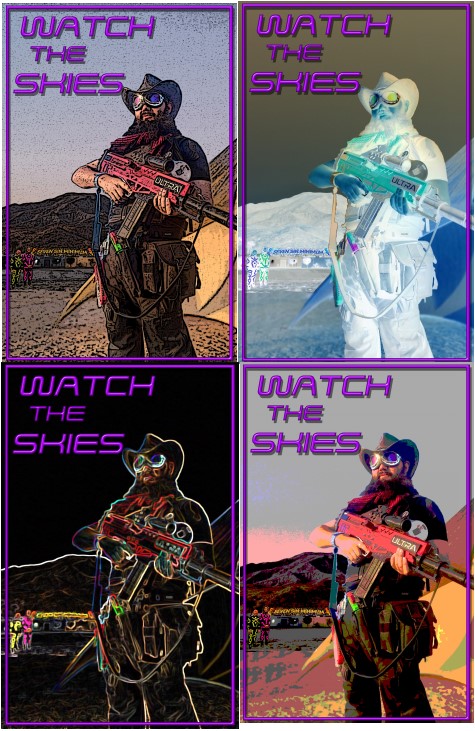
Along with writing, running games and creating stories I still create art. Well ‘art’ is a strong word, but I still make covers for Watch The Skies. At this point I know I’ve done more than 200 different pieces. Working and reworking those covers is a process. I’ve gotten a lot better and a lot faster at the process over time, but there are still a series of choices that have to be made each time. Sometimes I create options for the covers that never see the light of day. This month was an example of my method and I thought it would be a good idea to post up a couple of the options just for the sake of seeing the process. 

 When I’m working with photos in particular for any of the things that I’m creating, I often will use various filters through the computer to make these pictures look more seamless than they really are after I’ve compiled all the pieces. I know that using filters isn’t necessarily the same as drawing and/or painting with color to create the same effect, but given a shortened time frame the computerized tools are generally the option I need to go with.

 Here are a couple of alternates that I created for this month’s cover of our Fanzine.

Copies for each variation. I'm still partial to the neon in the bottom left corner.

Hopefully seeing these variations and knowing that there were other covers, other pieces that were attempted and discarded would help anyone who’s looking at the process of others in order to inform their own working steps. Creating a draft for writing is essentially the same thing. Computers are fantastic for copies. You have the ability to create a thing, then take that base and start again in a different direction. Running multiple iterations until you find the one that you think will work can be a long process. I think that could be an interesting discussion topic actually – how many iterations of a thing are you comfortable with before you put it out where the public can see it?

Dungeons & Dragons – The Series?

There has been some recent (well, relatively recent but I’ve been slow to post) buzz around a television series based on Dungeons & Dragons.

In theory, this makes me happy. The issue is that being too excited to see something like this frequently leads to a big let down or massive disappointment. I’ve been burned in that department before (looking at you D&D movie from 2000). Sure, the latest film Honor Among Thieves did really well and was a lot of fun to watch. It had some great moments and an enjoyable story. There were big name actors involved who actually took on the story, rather than taking on the roll as a… diversion or escape from some other engagement they didn’t want to deal with. I liked it and I’ve watched it more than once. I went and bought a DVD (yes, hard copies personally owned are still a thing) to support the idea that they should make more.

So, why am I not more excited about this?

Fantasy is a very easy genre to do badly. It’s also super easy to mock when it all goes wrong. It’s also maddening when the ‘fantasy’ aspect is wrecked in order to shoe horn in some standard Hollyweird bullshit that some executive who’s never liked that “geeky stuff” anyway thinks it needs. “Where’s the lovers triangle and who’s playing the handsome but misunderstood hero”? Insert vomit noises here.

The good – D&D is now socially mainstream enough that shows and movies are not immediately shelved. There’s hope that this new TV show (streaming show likely) will actually show D&D related things. Real actors, quality effects and a decent story. One article I read (like here) also gives some “geek cred” to the creators behind the process.

The bad – It’s a series, so there’s likely less in the effects budget and that’s kind of a big deal when it comes to magic spells and mythical creatures. It’s being set in the Forgotten Realms, but nothing more specific than that. That’s kind of like saying I’m making a TV show about the police and it’s being set in America. Thanks. Way to narrow it down. There’s an absolute mountain of material there, but that’s where the trouble always begins. The mountain of material falls into the trap of trying to mention it all. We even saw a peek of that in the movie. How many little ‘nod to the fans’ things were spliced between the scenes that moved the story? Can we use any of the things they used in the movie if this show isn’t attached to it? IF we can’t, does that mean we’ll never see anything else from the Red Wizards of Thay?

The worrisome – It’s being set up on Netflix as of right now. I like them as a streaming service generally. They are, however, notorious for giving a show five to eight episodes, letting it start to generate some buzz, then just killing it altogether. That would just make me more mad if all of the stuff above was actually navigated successfully and I was actually a fan of a good show and they axed it.

It’s a lot of unanswered questions. I’ll keep watching for more, but my hope is… guarded.